

Overview: Understanding Rent Increase Regulations in Dubai
Dubai’s tenancy laws are primarily governed by Law No. 26 of 2007, as amended by Law No. 33 of 2008, which collectively regulate the relationship between landlords and tenants. These laws explicitly outline the conditions under which a landlord may increase rent and the procedural compliance required to do so.
Article 14 of Law No. 26 of 2007 states that a landlord may only modify the terms of the tenancy contract, including rent value, by providing written notice at least 90 days before the end of the contract unless both parties agree otherwise. This provision remains a cornerstone of rent regulation.
Rent increases are not arbitrary. They must align with the rules set by the Real Estate Regulatory Agency (RERA), part of the Dubai Land Department (DLD). These regulations apply across most residential and commercial leaseholds in Dubai, excluding certain free zone jurisdictions like the DIFC, which operate under distinct legal systems (DIFC Law No. 1 of 2004 and related property laws).
The Role of RERA’s Rental Index in Determining Allowable Increases
The RERA Rental Index is the cornerstone of rent regulation in Dubai. Updated quarterly, it benchmarks average rents across property types and areas. If a landlord wishes to raise rent, the current rental amount must be evaluated against this index.
The allowed percentage of increase depends on how much lower the current rent is compared to the RERA benchmark. These brackets are:
- No increase if rent is within 10% of the average market rate
- Up to 5% increase if 11-20% below
- Up to 10% increase if 21-30% below
- Up to 15% increase if 31-40% below
- Up to 20% increase if more than 40% below
Landlords and tenants can verify rent thresholds using the official RERA Rent Calculator.
The index is especially relevant for long-standing tenants whose rent has not adjusted in years, ensuring balance between fair market practices and tenant protection.
When and How a Landlord May Legally Increase Rent
Under Dubai tenancy law, a landlord may only propose a rent increase if a 90-day written notice is served before the lease renewal date. This notice must clearly state the new proposed rent and reference the applicable RERA index data.
Failure to provide proper notice invalidates the increase, and the lease will renew at the previous rate. Importantly, increases must remain within the legal thresholds determined by the rental index.
Case Study: In 2023, a tenant in Jumeirah Beach Residence successfully challenged a 15% increase where the RERA index only allowed a 5% rise. The RDC ruled in favor of the tenant due to insufficient documentation and an invalid notice.
Disputes Under Dubai Rent Increase Law 2025: Tenant Rights & RDC Process
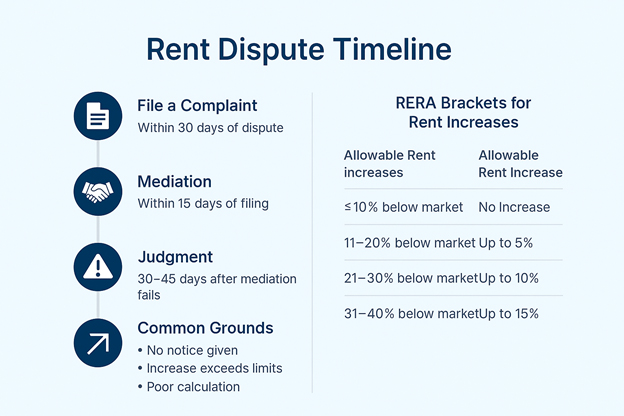
Tenants have the right to dispute unlawful or excessive rent increases. The Dubai Rental Dispute Centre (RDC) offers a structured process for filing complaints, starting with mediation and escalating to adjudication if needed.
Dispute Resolution Timeline:
- File a complaint: Within 30 days of the dispute
- Mediation: Within 15 days of filing
- Judgment: Typically issued within 30–45 days post-mediation failure
Common grounds for tenant disputes include:
- No notice given within 90 days
- Increase exceeding legal brackets
- Improper documentation or calculation
Landlords found in breach may be ordered to maintain the old rent or compensate the tenant. The RDC also has the authority to reject increases that contradict market trends or violate public policy.
Tenants are advised to retain lease agreements, previous correspondence, and evidence of rent payments when filing a complaint.
Dubai Rent Increase Law 2025: Compliance Checklist for Landlords
To ensure compliance, landlords and property managers should:
- Issue written notice at least 90 days before renewal
- Use the RERA Rent Calculator to determine eligibility
- Document the index comparison with screenshots or PDF evidence
- Retain all communications with the tenant
- Cap increases within the legally permitted percentage
Best Practice Tip: Use registered courier or email acknowledgment systems for delivering rent modification notices to establish legal proof of delivery.
This is particularly critical for those managing large portfolios or high-value leases, where disputes can lead to reputational risk and financial liability.
Frequently Asked Questions
Can my landlord increase the rent without notice?
No. A 90-day prior written notice is mandatory under Dubai tenancy law.
What happens if I disagree with a proposed rent increase?
You may file a dispute with the Rental Dispute Centre (RDC), which will assess the legality of the increase.
How often can a landlord raise the rent in Dubai?
Once per lease renewal cycle, and only if conditions under the law are met.
Does the rent cap apply to commercial leases?
Yes, unless otherwise governed by a separate free zone framework (e.g., DIFC).
What documents should I request or submit when a rent increase is proposed?
Request a copy of the RERA index calculation, formal notice, and supporting correspondence.
Is there a fee to file a dispute with the RDC?
Yes. A filing fee applies, generally around 3.5% of the annual rent (subject to a minimum and maximum cap).
Disclaimer: Dispute resolution fees are subject to change based on updates from the Dubai Rental Dispute Centre (RDC) or related authorities. Investors and tenants are advised to verify applicable fees through official channels or legal counsel before initiating a claim.
Can a landlord refuse to renew my lease to avoid rent cap compliance?
Non-renewal without valid legal grounds (e.g., property sale, demolition) may be deemed retaliatory and challenged under Dubai rental law.
Fractals Legal Consultancy remains committed to offering precise, compliant, and strategic legal counsel for property owners, asset managers, and UHNWIs operating in the UAE real estate market. For bespoke advisory, contact our real estate law desk.
Final Note
For case-specific guidance or legal due diligence on a proposed rent increase or renewal negotiation, contact Fractals Legal Consultancy. Our real estate law team provides discreet, documentation-driven support tailored to property owners, landlords, and tenants.